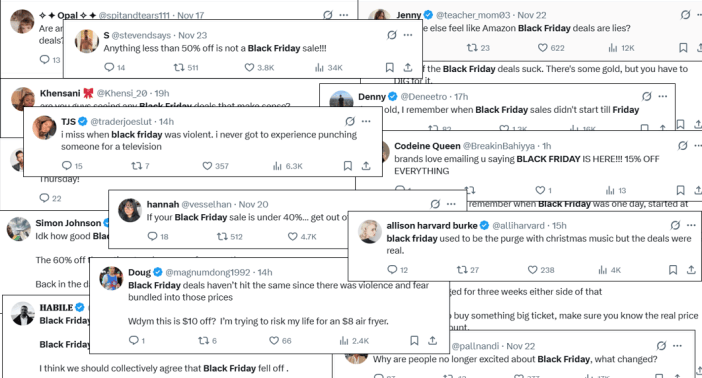
What happened to Black Friday? There’s no line forming in the wee hours of the morning. News channels haven’t shown a mall stampede in years. Discounts feel insulting. What gives?
.
Short answer? The internet.
Long answer? Holiday shopping looks very different than at the start of my retail career 15 years ago. (Target intern for Entertainment & Electronics – peak Black Friday culture). Here’s what’s gone down:
Loss Leaders. The year is 2008. You find out about Black Friday deals in the Sunday paper (unless you were the hardcore type that knew BFAds.net). You have 4 days to negotiate with family about how to chart your day – where to start, which deals live where, what’s going to sell out. Line up at 3am for your top priority – the store with the most products of interest and / or most urgency. Move on to the next store where you have a slightly smaller list. Rinse and repeat through 3-5 retailers. Around lunch time, most shoppers have run out of caffeine, adrenaline, and big purchase dopamine. Time for leftovers or the shopping center’s Applebee’s.
On the corporate side, we knew two important things. One, you can’t shop everywhere. How do we get you in our doors. Two, carts get progressively smaller as the days go on. How do we get you in line with us?
Enter the doorbuster.
The doorbuster was a coveted item, exceptionally discounted, in limited quantities. Sometimes it wasn’t even profitable. We just knew most shoppers would build a profitable cart. Lose money on an iPad, make money on the case, screen protector, and stylus. Lose money on a DVD player, make money on the old nostalgic DVDs in a cardboard tower by checkout. Lose money on the KitchenAid mixer, make money on the extra adapters. Not to mention, shoppers are making impulse purchases in cold weather accessories or buying a few grocery items to stretch a lopsided proportion of leftovers.
Today? More people are shopping online. A ton more. Only 3-5% of Black Friday sales happened online in that era. Now it’s 60%.
We can’t monopolize your purchases in the same way. Spending is getting more fragmented. Instead of 3-5 stores, you’ll hit 5-20 websites. And that’s not including aggregator sites like Google Shopping and price comparison sites that land you in web stores you’ve never even heard of. And around a third of shoppers are using AI to “visit” those sites for you.
You’ll buy the mixer from one site. Buy the dough hook from another (plus some toothpaste to hit free shipping thresholds). You find the pasta press in like new condition on eBay. When you can find the best price on anything with surgical precision, retailers are less inclined to set something on fire to get your attention.
Oh shit, it’s OSHA. We make a lot of jokey jokes about people getting trampled or beaten for good deals, but the government wasn’t laughing.
In 2008, a Walmart employee named Jdimytai Damour died in a shopper stampede. He was hired to a temp role the week before and assigned to the morning doors due to his 6’5”, 270lb frame. The crowd crush broke the glass sliding doors and shoppers surged in, killing Damour and injuring several other shoppers and employees.
OSHA investigated, finding evidence of dangerous crowds in years prior that damaged the entryway. They cited Walmart for not protecting employees from a foreseeable hazard and assigned the maximum fine ($7000, as maximums had been adjusted in decades).
But the incident was still expensive for Walmart. They wanted to avoid criminal charges, so they made a settlement with the Nassau County DA for $2 million: $400k to be distributed across 12 victims and the rest into the county’s social programs. Damour’s family and one injured victim both forfeited the public settlement in favor of their own civil lawsuit. Both were settled confidentially.
In 2010, OSHA and the DOL approached 14 major retailers about crowd control and employee safety. That’s government-speak for “fix this yourselves or we’ll regulate it for you.” And it raised the stakes of future lawsuits – easily to claim negligence when you’ve been warned by the executive branch.
Stores responded – opening Thanksgiving evening, staggering doorbusters across different time slots, extending the lower-excitement deals beyond the 1-day event, making deals available online.
And while consumer psychologists assumed that the mad frenzy environment would hijack people’s prefrontal cortex and make them more impulsive, we didn’t really see a downside to the change in tactics. Retailers made just as much money during a more measured promotional environment. Any downside from a safer, calmer event was eclipsed by post-recession recovery and the newfangled realm of online shopping. The event was allowed to evolve.
Amazon Pricing Rules. In 2010, Amazon bought a site called Woot! which was like an internet fire sale TJMaxx. They sold 1 item per day, deeply discounted. It either sold out or the deal expired at midnight.
Amazon liked the concept and incorporated Goldbox Deals or “Deal of the Day” onto their core site. For normal shopping days, a deal needed to be the lowest price in 30 days. But for marquee events, it had to be the best price in 365 days.
From 2010 to 2016, the DotD helped Amazon hijack a brick-and-mortar sales event into a multi-channel retail event. Their deals were good, with retail analysts crowning Amazon as the deepest discounter of them all.
But then they launched Prime Day. Hard to be the best deal of the year with multiple marquee events. Then another Fall Prime Event. The pandemic caused supply chain disruptions, disruptions became a classic “supply and demand” curve, driving inflation. The 365-day window just wasn’t workable.
So they made all deals under similar guidance: best price in 30 days. The 90-day price history both on- and off-Amazon becomes the “reference price” (i.e. used to calculate percent off). And that leaves a lot of room for fuckery. If a seller doesn’t have a ton of organic demand in late October / early November, they can nudge the price up for better deal optics on site.
And this problem didn’t evolve in a vacuum. In our current retail environment, there are 2 major factors. One, costs are extremely volatile with tariffs, war, increasing material cost, increased shipping costs. And two, the customer is becoming more and more deal dependent since the 2022 inflation issues. They know how much things used to cost. Their wages haven’t kept up. This isn’t WW2 where people felt a patriotic duty to accept the economic fallout of war for the greater good. Consumers are holding out for discounts to try and maintain their standard of living (partly driving the 3-month long Black Friday promos as well). For a multi-seller marketplace like Amazon, those two variables make a one-size-fits-all pricing strategy particularly challenging.
And Amazon’s far from alone. Department stores, Eddie Bauer, Wayfair, Old Navy, and Gap are increasingly using a “high/low” pricing strategy with an overpriced anchor and frequent promotional activity to manufacture urgency.
The other thing to note is that discount manipulation predates the internet. FTC guidance came out in the ’50s and ’60s based on a pattern of misleading and inflated reference prices. It happened in brick-and-mortar stores in the peak Black Friday era – a Macy’s luggage issue and Target TV both come to mind. Only 8% of discounts were exclusive to Black Friday (or best price all year). We just didn’t have an in-store equivalent of Keepa or CamelCamelCamel to expose the price history.
Resellers. There is a multi-billion-dollar industry of resellers called the “grey market.” They don’t buy direct from brands. Instead, they scour the earth for things to sell online for a profit. Some units are sourced brand new on closeout at Big Lots. Some are counterfeit. Some are factory seconds or open box products they try to pass off as new. Some preys on retail loopholes (like Amazon doesn’t ask for food products to be returned to make a refund. People will exploit this to source food for free and sell it on eBay).
If a brand discounts online too deeply, resellers will use the discount to source product. They buy a bunch of units and once the promo ends, they sell their product and price it in between the normal and promo pricing. The customer promotion turns into a rogue seller sourcing opportunity.
Sounds harmless. The problem? The brand has explicit directions for their authorized retailers on how product is supposed to be palletized, stored, and handled. Temperature and humidity impact cosmetics, appliances, and electronics. Health and beauty categories have expiration dates. Any products at risk of damage are explicitly packed on pallets with cartons in certain orientation or shrink wrapping.
The reseller has none of that. What do they have? Low margins. High motivation to take the cheapest option, even if it means stacking pallets that can’t support the weight or shipping cosmetics FedEx Ground in the summer or storing electronics in a damp, musty basement.
On marketplace sites like Amazon, few customers ever consider the seller. Fewer look into whether they offer free returns or warranty. They just know they bought a Vitamix Blender or Sony TV or Medicube Pore Pads. And when the product arrives broken, smells, or stops working after a few weeks, they leave a 1-star review on the product and that they’re “never buying Vitamix again.” Worse, some customers reach out for warranty only to find that their 3 week old $700 espresso machine doesn’t qualify.
The prevention? Careful discounts. Resellers are targeting 8-10% margin after all their costs are factored in. Working backwards, that means brands can’t offer doorbuster discounts anymore – their floor is -30% to -40% off, depending on the product category. Deeper and they’re creating serious customer service and customer loyalty issues.
This issue existed before the internet (cue up Jingle All the Way from 1996). But it was niche. You couldn’t clear out doorbusters from multiple stores the way you can buy online. It’s harder to circumvent quantity limits when you’re standing in line vs. creating multiple customer identities online. And there weren’t as many places to sell that product profitably. Rogue sellers sell “new” stock on eBay and Amazon for almost full price. That didn’t happen at the flea market, yard sale, or pawn shop where analog resale happened.
Does a “Save 20-30% on EVERYTHING” discount kinda suck? Yea. But also keep in mind the total discount rate from the Doorbuster Days once the full cart is considered.
And on one hand, there’s considerable pricing manipulation in the market that’s deeply eroding customer trust in discounts. And retail has also changed drastically since the 2000s, which we ultimately drove by adopting online shopping. Product pricing strategies may not seem “digital” vs. “analog” at face value, but they are. And unless our virtual “shopping center” somehow shrinks in the future, the Doorbuster Days are done. “We threw punches over a deeply discounted Blu-ray player” is becoming the millennial equivalent of walking uphill in the snow to school both ways.

