Is it green or greenwashing? This series looks at the sustainability practices of reader-nominated brands. For more details on the project and a bit about my background, the project page is here. This piece focuses on REI Co-op.
Now, this is where I’d usually dive into my 5 main tenets of sustainability: sustainable fiber types, physical and stylistic durability, legally compliant eco-claims, mindful of end-of-life sustainability, and avoiding marketing tactics that drive overconsumption.
But REI’s biggest initiatives fall outside that framework. So first, we’ve got to take a big detour to talk about industrial chemistry in apparel:
Yikes, talking about chemicals on the internet. Textile chemistry is a frustrating topic due to a lack of understanding. Two things can be true: chemicals in textiles are a global public health issue, but most US consumers do not have threats to their health and safety hanging in their closets.
Starting on the consumer side, all clothing is chemically processed. It doesn’t matter if it’s “natural fibers,” organic cotton, virgin polyester – there’s chemical processing to create, clean, bleach, and dye the fibers. This is not a threat to consumers for 2 reasons:
One, skin is selectively absorptive, somewhat permeable, but mainly a protective barrier. Two, we have some layers of consumer protection. Kids’ clothing is regulated by the CPSC for heavy metals, phthalates, and formaldehyde on finished garments. And brands started their own “Restricted Substance Lists” that added more substances and extended coverage to adult clothing lines.
Brands also started adopting programs like OekoTex 100, which tests final garments for chemicals. Or there’s ZDHC (Zero Discharge Hazardous Chemicals), which removes many chemicals from the supply chain all together and harmonizes restricted substance lists from major brands around the world for consistency (and therefore easier adoption).
Essentially, if you’re buying clothing from a large brand, you’re probably protected. The gamble is the Shein & Temu tier, or those Instagram brands that give off “we’d rather make a buck today than have our customers be alive for the long haul.”
Okay, got it. How does this relate to REI?
REI is a Bluesign partner. Bluesign is the crème-de-la-crème when it comes to industrial chemical management. Their system is unique in that they’re equally focused on consumer and garment worker health and safety.
When we say that “apparel is a nasty, chemically polluting business,” the real victims are textile workers and the communities that live around mills and factories. You and I are exposed to trace levels of chemicals. Mill workers have high concentration exposure, day-in-day-out, often in buildings with low ventilation and little PPE. They also breathe in fumes, off-gassing, and textile dust, meaning these chemicals are getting absorbed more easily compared to wearing the garment and dermal absorption. Then, in countries with lax wastewater regulations, those same chemicals get dumped into the environment, creating further exposure for the surrounding community.
Bluesign just generally doesn’t fuck with risky or harmful chemicals. (With some exceptions; they were fairly late to the program with short-chain PFAS). They have the longest list of restricted substances. They have the most intense auditing. They’re the only ones with an explicit mission to protect garment worker health. (Others do so as a byproduct of pollution goals). They also set standards regarding factory energy efficiency, water efficiency, and air emissions.
Bluesign limits the supply chain considerably, shrinking it down to vetted mills, factories, trims manufacturers, and chemical suppliers. And therefore, it’s hard to both Bluesign and recycled materials in an aggressive manner.
For comparison, REI has 70%+ Bluesign coverage, but only ~60% are made from recycled & renewable fiber types. Meanwhile, Patagonia has 58% Bluesign coverage, but virtually 100% coverage from recycled & renewables.
Which is better? That’s beyond my scope of expertise. It feels like the ethical trolley problem where you have to decide between poisoning globally marginalized communities or burying them in trash. Recycled materials tend to be “low hanging fruit” – high availability, low friction for businesses to swap, easy to measure progress and ecological impact. Bluesign is more tedious – taking years to swap an existing product over to all certified supply chain players. The impact isn’t just math; it’s one of few sustainability systems that values non-quantifiable ethics considerations. (How many tons of CO2 are equivalent to garment worker health and mortality?)
I am impressed that REI is pursing both goals, plus the added constraint of being a private label brand where customers expect lower pricing than name brands (many of which being less aggressive towards these goals).
Okay, back to the originally scheduled programming:
They use more sustainable fiber types: recycled synthetics, closed-loop semi-synthetics, and regenerative natural fibers.
As mentioned, Bluesign greatly constrains the supply chain and makes recycled content sourcing more difficult. REI’s spent 17 years clearly prioritizing Bluesign to get to ~70% product coverage and therefore has not made the same progress in sustainable fiber sourcing. Roughly 60% of their women’s assortment uses mostly recycled or renewable materials. That 60% leans a little more heavily into wool base layers, wool-blend socks, and cotton lifestyle apparel.
But narrow that down to their synthetic items, only 48% of those are using any recycled material. That’s not great in the outdoor space – a little ahead of Arc’teryx, who has a reputation as a late adopter when it comes to sustainability. This also puts them behind Patagonia (98% of synthetics are recycled), The North Face (81%), Nike (66%), and Outdoor Research (59%). It does put them ahead of other budget brands like Columbia (31%) and Free Country (13%). They didn’t even set goals for recycled synthetics until 2021.
Is it a decent percentage given their Bluesign constraints? Really hard to tell since many brands prioritized recycled content and have lower rates of Bluesign coverage. Overall, I’d say solid, but not best in class. (That’s Patagonia’s 58% Bluesign certification while also sourcing 98% recycled synthetics). But I also have some personal challenges when it comes to their REI’s choices with virgin synthetics. For example, the Sahara Hoodie is one of their bestselling pieces and is 91% virgin polyester. For 2026, they added a secondary version with a straight hemline. Should they be iterating and adding to their virgin synthetics line, or should they put that effort into sourcing more sustainable fabrics? I interpret their choice to do the former as a sign they don’t care.
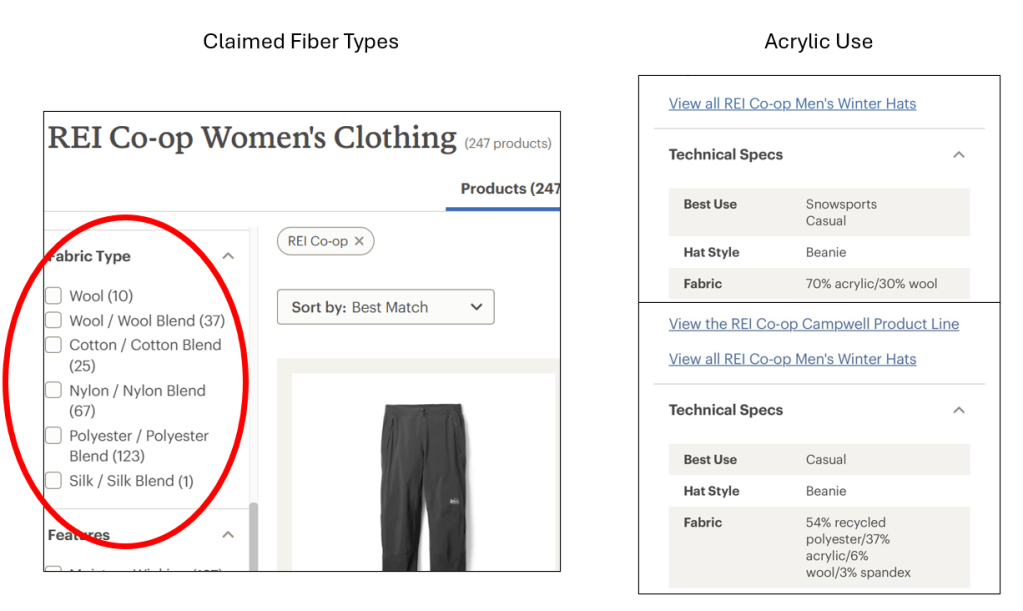
They also pull some sneaky, shady moves on their website. At first, I was pleasantly surprised to see no items with acrylic in their women’s brand store. Acrylic has terrible durability, is horrible for garment workers, but it’s super common in winter beanies (especially since accessories are more likely to get outsourced for design & development). When I checked REI’s Co-op apparel pages, acrylic doesn’t populate in the filter function – looks promising. But then I looked into the actual items. The Lightweight Logo Beanie is 70% acrylic. The Campwell Beanie has 37% acrylic. Could it be a mistake in the product data? Maybe. The Campwell doesn’t show up for Polyester either (but they did make sure it shows up under Recycled Materials). But it’s really icky to me that they might be trying to cover up some of their most problematic material usage.
Pieces are built for the long haul: not only are pieces physically durable, but they’re durable in the face of trend cycles. They’ll be relevant in your closet for years and capture strong resale value if they’re cycled out.
Physical durability isn’t super straightforward with REI. In the “good, better, best” product tiers, they compete heavily in the entry price point (good) tier and a bit in the mid-price (better) price band. Accessible price points are never going to be the most durable.
But the star ratings suggest that people are generally pleased with the value-for-dollar. They don’t make a lot of junk. I know they have a wear test program, where prototype samples are distributed to employees or a special set of REI members. They put gear through its paces and then answer questionnaires about fit, quality, and performance.
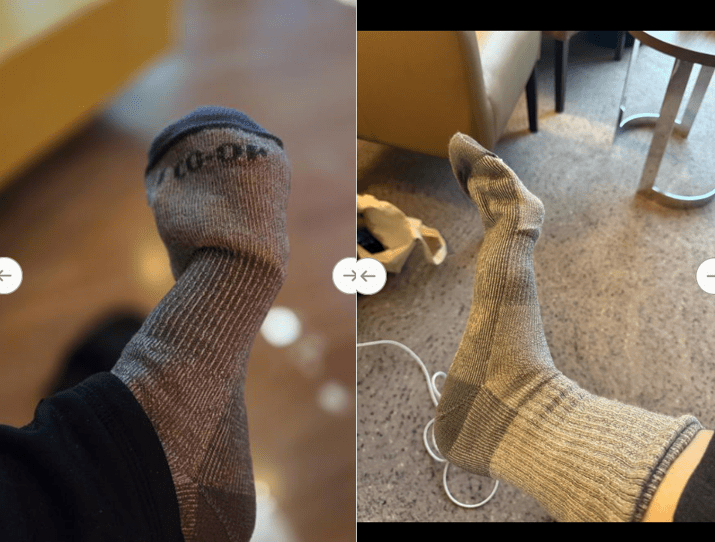
There are a few areas where customers are dissatisfied, but they’re mostly items like a $99 rain jacket where high performance waterproofing just isn’t feasible at that budget. Or there were a series of REI Coop socks with laughably long toes, but those mistakes are very few and far between. From a product standpoint, I like that REI strips out costs that come from aesthetics and invests in places that maximize performance and durability.
From a styling standpoint, fashion is a low priority at REI Coop. Most items are solid colors, barely influenced by trend cycles. Silhouettes are mostly tried-and-true basics. They occasionally dabble in medium-length trends, barrel pants, cropped tees, quilted cardigans. They rarely become best sellers, so I think REI mostly stays in their lane: real outdoor gear made in a cost-conscious way.
They follow regulations on how to market green initiatives. They don’t rely on generalized, debatable terms like “eco-friendly” or “sustainable,” and instead use fact-based language that’s reflective of their actions.
Solid work here. They rarely stuff titles with recycled or organic content claims. Likewise with the product description above the fold. If we want to get extremely picky, there’s some room for improvement for blended fabrics on mobile browsers. Let’s use the Flash Hyperstretch Fleece Jacket as an example. On mobile, customers see bullets first: “Recycled polyester hard-face fleece.” But scrolling further, it’s a blend that’s 54% recycled. If we’re really following FTC Green Guides, partially recycled content should always be clearly and prominently qualified by weight. In the desktop view, the bullets and “Tech Specs” (which start with fabric content) come up together, splitting left and right screen where there’s less potential for confusion.
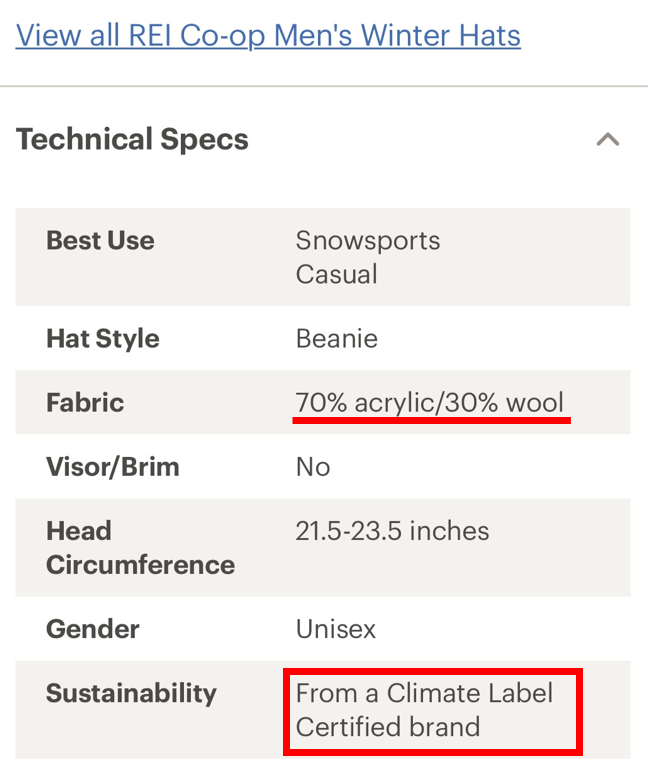
REI also calls out that they’re a “Climate Certified Brand” on all Coop products. This means they’re working to reduce their carbon footprint and purchasing carbon credits / carbon offsets. Carbon offsets are essentially a grant for someone else (often developing countries) to change their behaviors so we don’t have to change ours. Often there’s a Western corporation implementing these changes and profiting from the changes. They’re better than nothing, and I like that Climate Certified Brands are challenged to improve their emissions. But it ventures into greenwash-y territory to slap a “Climate Label Certified” brand on virgin synthetics, especially acrylic. It’s like they want their sustainable brand choices to cast a halo effect on their least sustainable products. Here’s that same Lightweight Logo Beanie that’s mostly acrylic with sustainability callouts:
They’re clear on how products are made and how to best dispose of them: transparency about the brand’s green claims builds trust with consumers.
REI’s had some starts and stops with circularity. They had a long history of “Garage Sales” for used product returns. Customers waited in line for specific sale dates and clambered over pretty modest discounts. In 2017, they launched an eCommerce beta which later evolved into ReSupply. It opened up way more opportunities for circularity. Items did not need to be REI purchases, so long as it was a brand / product they carried. Consumers could mail in their trade-ins – no need for proximity to a store.
In 2025, REI shuttered the site experience and dropped the 3rd party partner. Instead, they set up used gear zones in their stores. Trade-ins for non-REI purchases are still kosher, but the trade needs to happen in store (limiting eCommerce customers far from a location).
As a rural, eComm customer, I’d love to see it back one day, but I get it. REI’s been under intense pressure to re-establish profitability. The in-store model drops the 3rd party contract in favor of their existing staffing. It maximizes circularity while managing costs.
They don’t play games with customer demand. Merchants have some tricks and gimmicks to manipulate customer demand: short term promotions, limited time offers, limited quantities and “a few units left” messaging. Sustainable brands give customers the time and space to decide whether they really want an item without creating pressure and mark down what’s left at the end of the season.
REI pulses Coop brand promotions alongside their usual promotional calendar. The discounts run for relatively long periods of time where customers aren’t spending out of urgency. They do push urgent messaging for clearance styles (“HURRY! This item is discontinued. Shop now for best selection.”). Low stock gets a yellow banner (“order soon!”). But outside of their copy choices, they’re doing little to prompt panic buying behavior.
And while few people use their 20% off coupons for Coop apparel (usually it’s reserved for big ticket items), I don’t love how it influences consumers and disrupts the purchasing process. Instead of finding a product and developing the urge to buy, these coupons make customers want to buy something – anything – and then search for a product to satisfy it. It’s a psychologically effective mix of “spaving” messaging, artificial urgency, and FOMO to inflate demand.


Love the deep thought you put in to these postings. It sheds more light on a world that I have only a passing acquaintance with. THANK YOU for taking them time to think, research and write it.
Small note: it did seem like there is a word missing from this sentence (toes, perhaps?): “Or there were a series of REI Coop socks with laughably long, but those mistakes are very few and far between.”
Cheers, Melissa
LikeLike
Sure did – appreciate the catch!
LikeLike