Whenever I put out a gift guide, winter skin care and hair care items are reliably some of the most popular gift ideas. So, I wanted to expand on the topic with a longer piece about how the cold air interacts with our bodies and how to protect them on the slopes.
A few disclaimers before we dive in: Black women wrote the Bible on protective hair care; this is just an adaptation. If it looks or sounds familiar, it’s because this is following their blueprint. Second, I have no qualifications beyond living in the high desert and being a frequent hair donor. Trust your derm if they’re saying something different. Third, beauty carries no moral value, and I feel a little conflicted writing anything tangentially related. I’m interested in these topics, but I also think it’s really fucked that looking young, healthy, and attractive makes such a big difference in how you’re treated by employers, medical providers, and society at large.
We’ll start with skin care, since it’s an organ that actually serves a purpose in our health:
What happens: Winter weather affects the skin in a few ways. Our blood vessels constrict as the body prioritizes blood flow in the core, and metabolic processes slow down. Most severely, this can cause frostbite, where the lack of warm blood flowing allows other fluids in our tissues to freeze and damage or kill off cells. But even in milder temps, our skin produces fewer lipids and filaggrin proteins, which are important for our skin’s barrier function. For some people, this affects their entire face, while others get combination skin as their t-zone starts producing more oil. Further, cold air holds less water, so we experience more transepidermal water loss as water evaporates out of our skin and into the atmosphere. Wind makes that issue even worse – as we lose water to hydrate the air around us, that air is whisked away and new, dry air takes its place. And sun can also do damage on clear days, since mountain elevations and thinner atmosphere don’t filter our as many UV rays, and snow reflects that light as well.
On the mountain:
Cover what you can with a buff, balaclava, and/or goggles. This keeps skin warmer and blocks wind and sun.
Use a product with occlusive ingredients. Occlusives are a skincare ingredient designed to seal moisture into the skin, but don’t necessarily add any moisture to it. Occlusives include butters (think shea or cocoa), waxes, petrolatum, squalane, dimethicone, and some oils, like coconut and mineral. There are lots of affordable options, like Vaseline, Aquaphor, or pure coconut oil. I use a Trader Joe’s balm made of shea butter and beeswax ($3.99 in store), while a similar Dr. Bronners balm uses avocado oil. For easier application, Mustela and Palmer’s Cocoa Butter both make a balm stick. Generally, if it’s got “balm” or “ointment” in the name, you’re on the right track. Same if it kinda feels like you’re applying lip balm all over your face. Some occlusives can clog pores, so make sure to wash them off at the end of the day, and go with one where occlusives aren’t first in the ingredient list if they give you trouble.
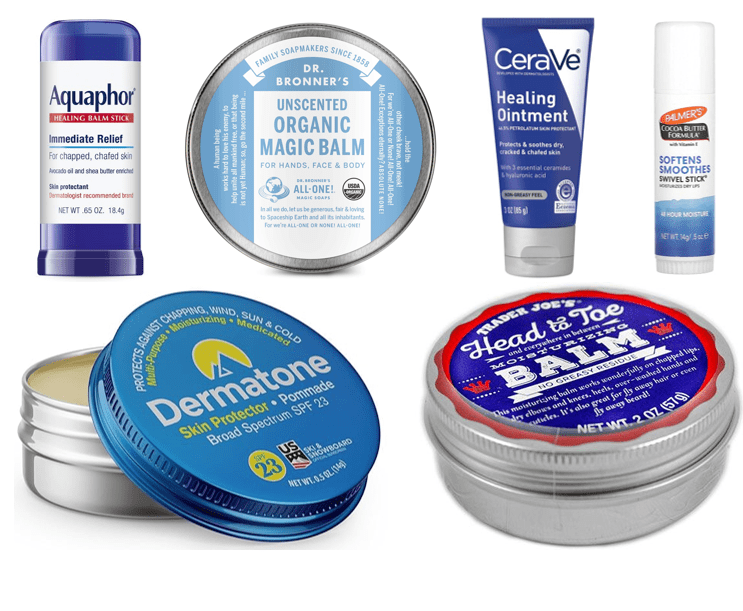
Apply UPF. A product like Dermatone or a sunscreen stick can do double duty between sun protection and an occlusive barrier.
Hydrate. We tend to take hydration seriously in warm weather sports. For skiing and snowboarding, we drink a coffee or an energy drink for the drive up and have a beer at the lodge, but do as I say and not as I do: make a point to really hydrate during the day.
Après ski:
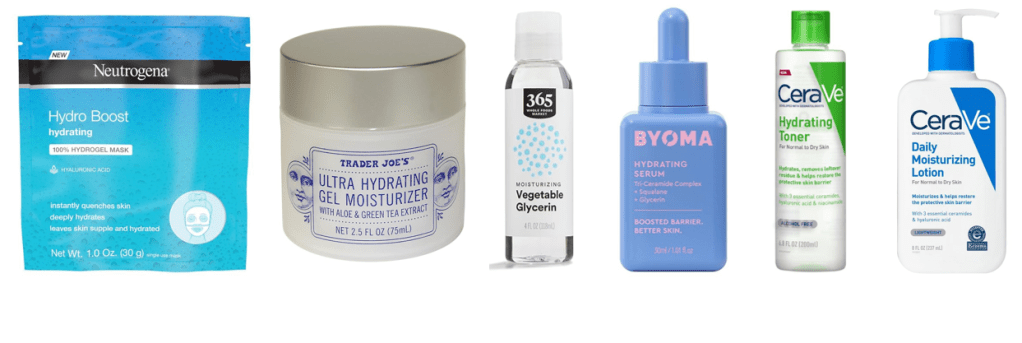
Use humectants after a gentle cleanser. Humectants deliver water into our skin cells. Humectants are a key ingredient in a number of products: moisturizers, serums, masks, oils, toners. Look for ingredients like glycerin, jojoba oil, urea, hyaluronic acid, and AHAs. I love a Neutrogena Hydro Boost sheet mask after a day outdoors, but settle for a few drops of jojoba oil or a layer of Trader Joe’s Hydrating Gel Moisturizer when I don’t have the time.
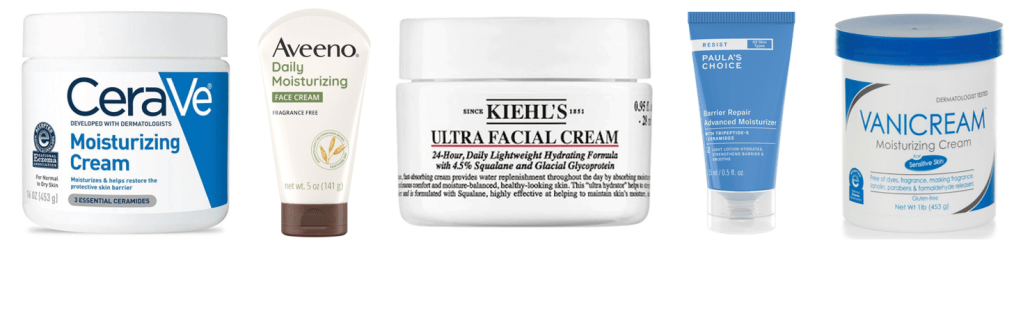
Finish off with a thick moisturizer. A thick moisturizer or night cream will check all 3 types of hydrating skincare ingredients: humectants to deliver moisture, emollients for smoothing, and occlusives to seal everything in. I live and die by the Cerave Moisturizing Cream, but the skincare aisle is teeming with good options.
Which brings us to hair care for cold, snowy weather:
What happens: Cold air holds less water, so just like it draws moisture out of our skin, it pulls moisture out of our hair. When it does, the protective outer cuticle of the hair lifts slightly, making the hair more susceptible to tangles, breakage, and damage. Hair also gets weaker if it gets wet (like on warm storm days) because the protein structure and hydrogen bonds get weaker. And it’s worse if it refreezes – hair is porous, and water expands as it freezes. Our hair swells up, damaging the cells. We also experience a lot of friction from helmets and movement throughout the ski day.
On the mountain:
Reconsider slut strands. Those little whispies are already fragile. They contain more vellus hairs (baby hairs that are finer and weaker than regular “terminal” hairs). Plus, they’re right by our face, so they get more attention (read: damage) while heat styling. And a lot of us bleach that hair for face-framing highlights or a money piece. They’ve been through enough without being wet, frozen, dried out in the cold, and tangled in the wind.
Oil your hair. Oils help keep moisture from evaporating out of your strands. They also make hair slippery, which reduces friction between one strand and another, or between your hair and your helmet or clothing. Use a heat protectant already? Odds are good it’s protective against cold weather too. Same with leave in conditioners. I use the same jojoba oil I use for my face, or a heavier “argan oil” formula (it’s mostly dimethicone) if my hair’s been feeling really dry. Even a little olive oil, coconut oil, or sesame oil work.
Put it in a protective style for your hair type. Skiers with type 3c-4c hair use braids and twists both on and off the slopes to protect their hair. If yours is straighter and finer, there are still appropriate options: basic plaits, French braids, Dutch braids, fishtail braids, rope braids, pigtails, low buns or space buns. Essentially, you want a style that keeps hairs in place, reducing friction and minimizing the chance of tangling and matting.
Cover it. Just like a bonnet protects a person’s hair when they sleep, a silk or silk-y balaclava reduces friction from your ski helmet. It also keeps hair a little warmer, which helps keep the cuticle down and minimizes moisture loss. I also tuck the rest of my hair into my jacket. There’s friction from my clothing, but for me, my hair still feels better than leaving it out.
 FemiGnarly
You’re supposed to hold my hand while you roast me for my skiing hydration tactics…
LikeLike