Last year, I finally attended a Rippin Chix Resort Ski Camp. I spent 5 seasons thinking about their clinics before pulling the trigger, and I know a handful of women curiously interested, so I decided to write a review. And while my ski reviews tend to run for thousands of words about the perfect skier for a given setup, I can be a lot more concise when it comes to this clinic: do it.
“I think about what I learned in that clinic with every turn I make, every time I ski.” That’s the testimonial I got from a friend when I first learned about Rippin Chix. It seemed like a lofty endorsement, but she was absolutely right. If the last time you received professional instruction was as a child and/or beginner, you’ve probably got a few little bad habits. And they’re probably not so large that they’re preventing any fun or progression but could open up so many new doors if you fixed them with a little coaching.
As always, I disclose any material relationships between me & the companies I review. In this case there are none. They didn’t ask for this, nor did I share my plans to write this.
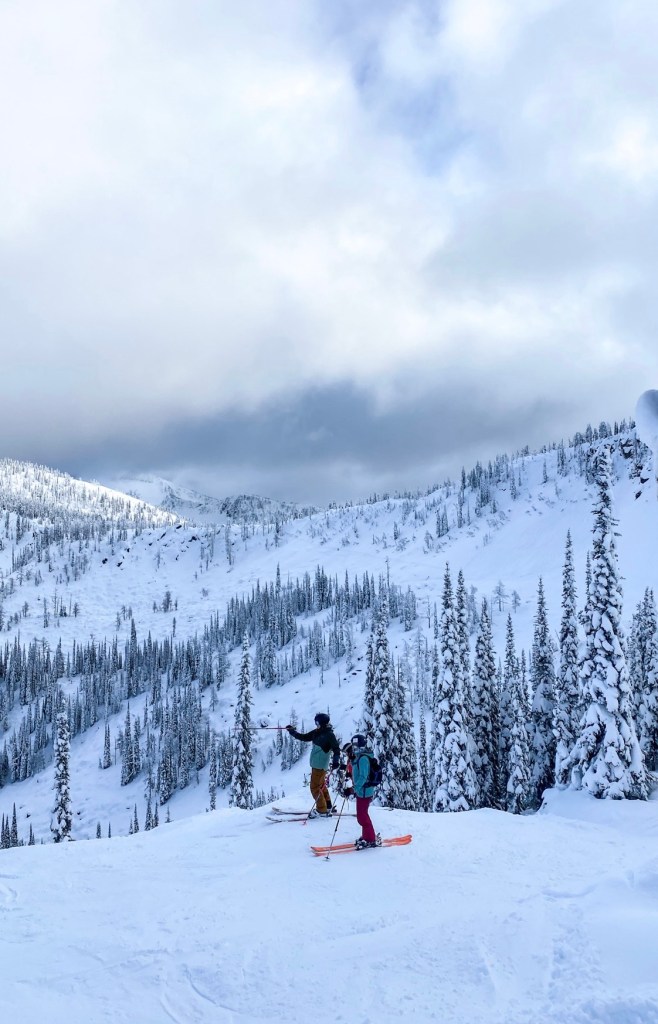
Let’s start with a little recap of how camp worked at Whitewater, BC:
- Pre-camp: There were about 24 skiers signed up for my camp weekend. We all received a long questionnaire about our ski background, fitness, and goals for camp. There’s a point system attached to the answers. You can request to be grouped with a friend, but they’ll assign you both the lower of your two point totals, so compare notes and keep that in mind as you answer the form.
- Day 1: Everyone met for a total group meeting with housekeeping & schedules. We were sorted into 4 groups of 6 skiers, but there are no rankings or labels attached to them. We started with a groomer warm up run, followed by a second groomer run that was observed and videoed by our instructor (in my case, co-owner Susan Medville). In just 15 seconds of observation, she had corrections for all of us. I learned my pole plants are verifiably insane. I’m reaching too far forward, but also opening my arms too far to the side. I’m putting my whole arm into it vs. just my wrists, and I’m lingering between turns with my pole pointed in front of me, which could really fuck me up if I caught the tip on something. We did another round on groomers working on corrections, and immediately I knew the $600 was worth it. Then we threw some mellow moguls in the mix, and I found myself reverting to bad habits, fighting to implement corrections, and eventually pole planting on the wrong side of my body all together. We also learned a few turn techniques – not your ski school’s technical carves – but the hop turns, side slips, and slarves that come in handy on “wild” terrain and snow. We practiced first on groomers, just envisioning the trees and terrain features of an ungroomed run, and then put them into practice on ungroomed single blacks after lunch.
- Day 2: One of my groupmates started the day with a request to get scared. Technique is important, but I find that fear brings out a lot of people’s bad habits. (Not mine though, they show up all the time). And most of us traveled all the way to Whitewater specifically for their steeps and techy features. Our instructor delivered, and after a few warm-up runs, we lapped steep, treed doubles off the Summit chair all day. We slowly dropped group members after lunch. Our group was fairly cohesive skill-wise but saw wider spread when it came to gumption. Some people don’t want to do scary skiing all day, lap after lap. Some folks are also traveling back for work the next day and wanted an early start to the drive. It seems like most groups saw similar attrition, and I appreciated that my instructor turned up the spiciness when the group dwindled down to braver skiers. Don’t get too salty if the skiing feels a little easy on day one.
I wish I could say that I left the clinic with consistently rehabilitated pole plants. It took a few days things to click and feel natural. I feel more confident at speed and nimbler. I’m also seeing benefits with skills I never worked on. My group didn’t get into drops and airs (more on that later), but fixing my arms makes me feel more balanced with takeoffs and landings and I feel more balanced in the air.
In terms of strengths, the coaching stands out. I was skeptical of taking classes from athletes. If the sport came naturally to them, could they break it down for those of us where it doesn’t? And athletes can dominate NCAA racing or the Freeride World Tour without great communication skills. The coaching delivered. It was the mix of theory and practice. The small group sizes mean you get feedback every other lift ride, often with a video replay. I also think they perfectly thread the needle between positive support and actionable feedback. Some women struggle with direct communication and critique; Susan is not one of them. I never felt self-conscious or embarrassed over the weekend, despite picking through my flaws over a slow-motion video alongside my peers. I think instructors have great faith your potential and dog you relentlessly all weekend to reach it.
Now, let’s talk caveats? Considerations? Grouping strangers based off a questionnaire is hard. Adding the emotions of ability level and ego make it harder. The owners’ goal is to make groups cohesive enough that everyone learns valuable material, and they’re delivering.
That being said, groups can vary. Some groups are lightning in a bottle, lots of supportive woo girls that build fast new friendships. Some groups just functional. Even within a group, you might be the weakest or most timid skier in the group, spending all day feeling stretched and scared. Or you might be stronger and the pacing from day 1 to 2 might feel a little slow. I accidentally went in expecting the best-case scenario and then felt a little unsatisfied when there wasn’t a speed demon to chase around or when lift ride conversation didn’t flow easily.
I also asked my instructor directly about groupings and I’m not sure that was a good idea. I joint sorted with my friend. I put drops & airs as a top priority on my survey while she did not and we sorted into firmly planted group. I learned that another group was working on jumps, a group that seemed to have chemistry with a team name and a mascot. I was jealous; I thrive off the peer pressure of skiing with much sendier women. And I second guessed where I would’ve sorted solo. I let it distract me. But her answer was also important for me to know there more levels to work towards. It’s what made me a repeat customer.
Go in with the expectation that there’ll be some level of compromise with your groupmates. It’s their clinic too. Otherwise book a private lesson. And don’t forget that fun groups are made of fun members. If you want a hoot & holler kind of group, put yourself out there and get it started first thing day 1.
Resort operations and weather are other considerations. Our Whitewater clinic overlapped with a freeride competition that monopolized some great terrain for part of the weekend. It also impacted lift lines (we queue in the regular line) and added lunch chaos to the lodge.
But weather’s also a factor. I’ll still choose a busy Whitewater weekend over other options because snowpack and temperature are dependable. I’ve heard some unverified accounts about deferral options in extreme cold, but I know for sure that rainy clinics at Alpental are business as usual.
If you’re interested in booking your own clinic, you can find their “tour stops” from this link on their website. If you find this review between seasons, the next year’s schedule drops in late summer, usually between July and August. Hope our paths cross at a future camp!
 FemiGnarly